
You know recognition matters. You've read the retention stats. Maybe someone on your team shipped a hard fix last week and got a thumbs-up emoji and nothing else. Maybe your best support rep has gone three months without one specific thank-you from anyone above them. But between payroll, benefits, and the other fifty things on your plate, building a real recognition habit for a 40-person team keeps sliding to next quarter, most of all when there's no dedicated platform or budget line to make it happen. Here are employee recognition ideas (call them employee appreciation ideas if that's the phrase your team uses) that cost nothing to try, work inside the Slack workspace your team already lives in, and don't need a formal program before you start today. Employees who receive high-quality recognition are 45% less likely to have left within two years, and replacing the ones who do leave now costs $45,236 on average, numbers worth acting on before the next review cycle, not after. OrgaNice built its kudos feature straight into Slack for this reason: recognition that requires a new login or a separate portal is recognition that stops happening without anyone deciding to stop it.
- Free and low-cost employee recognition ideas
- Employee recognition ideas that work in Slack
- Peer-to-peer recognition ideas
- Milestone and occasion-based recognition ideas
- Virtual employee recognition ideas for remote teams
- Small, structured ideas for teams ready to formalize recognition
You don't need all twenty. Pick two or three that fit how your team already works, run them for a month, and add another only once the first ones don't need a reminder to keep going. The ideas below run in rough order from lowest effort to more structured, so start near the top if you're building this habit for the first time.
Free and low-cost employee recognition ideas
No budget for a recognition program? These ideas work anyway. Each one costs nothing to run and needs no purchase order, no sign-off, no new line item in next quarter's budget. They work because they run on attention, which a small team already has, instead of money, which it doesn't. Try one before you add a recognition budget to next year's plan; most teams find they didn't need it.
1. A public, specific shoutout. Skip "great job team." Name the exact thing someone did and why it mattered. "Priya caught a billing error before it hit three customers" lands. "Priya's been doing great work" doesn't. Specificity is what separates recognition from a platitude, and it costs nothing but attention. Post it in the channel where the work happened, not a separate recognition channel, so the people who understand the context see it first. If you want more phrasing to start from, this guide to giving a shout-out to a coworker has real examples.
2. A handwritten note. In a Slack-first team, a physical note stands out because it's rare there. Keep it short and specific, to the same standard as the public shoutout above. Leave it somewhere they'll find it at the start of the day, a desk or a laptop bag, before the day's meetings crowd it out.
3. First pick on the next project or task. Letting someone choose what they work on next is a real reward that costs no budget and signals real trust in their judgment. Say why out loud: "you get first pick because of how you handled the last migration" turns a perk into recognition instead of a mystery reward. This works for smaller choices too, which client demo to lead, which conference to attend, as long as the reason attached is specific.
4. A five-minute recognition moment at the start of a team meeting. One specific shoutout, thirty seconds, at the top of a standing meeting that already happens. This is the lowest-effort way to make recognition a habit instead of an event someone has to remember to schedule on its own. Rotate who gives it each week so the job doesn't become one manager's responsibility by default.
5. A peer-nominated rotating title. "Team MVP of the week," decided by teammates, not managers. Peer recognition carries real weight: employees value recognition from colleagues almost as much as recognition from leadership. Let the current holder nominate the next one; it keeps the title moving and keeps any one person from holding it too long.
Employee recognition ideas that work in Slack
If your team already runs on Slack, recognition should live there too, not in a separate tool with its own login and its own adoption curve. These ideas turn channels your team already checks into the place recognition happens by default, so nobody has to remember a second workspace exists. The habit only survives if it costs less effort than skipping it.
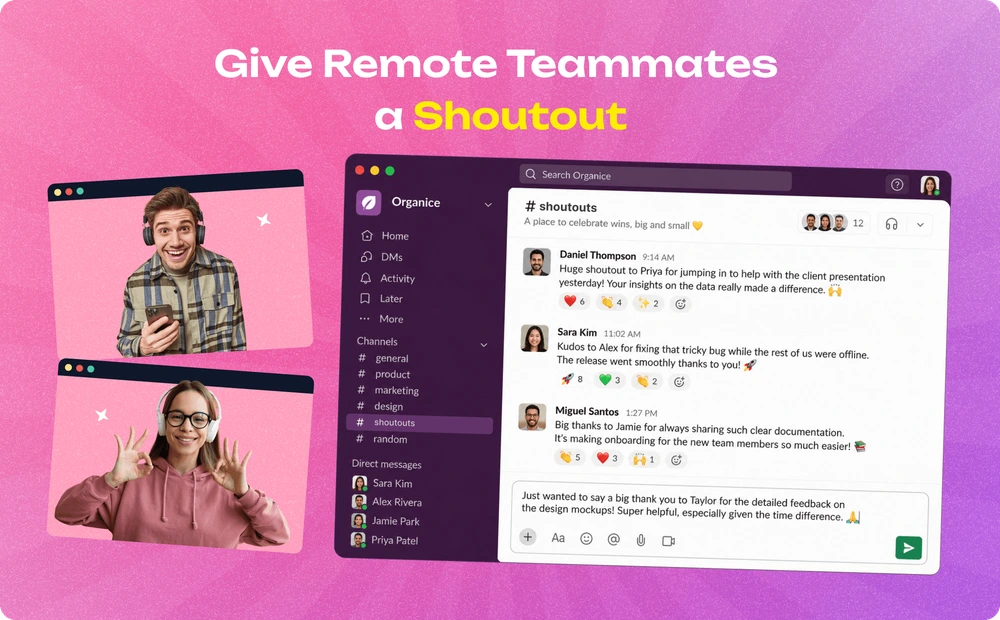
6. A dedicated recognition channel. A single #kudos or #shoutouts channel where anyone posts a specific thank-you, visible to the whole team, costs nothing to set up and removes the friction of a separate recognition tool nobody remembers to open. Seed it yourself for the first two weeks. Most channels like this stall not from a lack of interest but because nobody posted first. Pin two or three examples to the channel so new members see the standard before they post their own.
7. Recognition built into your existing Slack workflow. A kudos command or emoji reaction that logs recognition without anyone leaving the conversation removes the last bit of friction between having a thought and acting on it. This is the specific gap OrgaNice's kudos feature closes: recognition that happens where the team already is, not in a portal that becomes one more login nobody uses after week one. Setup takes minutes, which matters for a team without a dedicated HR or IT function to run a longer rollout.
8. A weekly recognition digest. A short, automated recap of the week's shoutouts posted back to the team channel turns individual moments of recognition into a visible pattern, which reinforces the habit for the next person deciding whether to post one. Keep it to five or six highlights. People skim a digest that recaps the entire week once and skip it the week after.
9. Manager replies in-thread, not only in DMs. When a manager praises specific work by replying in the thread where it happened, instead of a private message, the recognition becomes visible to the whole team without requiring a separate announcement. It costs a manager nothing beyond the thirty seconds a private message would have taken anyway. Over a few months, a team that sees this happen starts to expect specific recognition as normal, not as a rare event reserved for big wins.
Peer-to-peer recognition ideas
A manager cannot see everything. Teammates see the late-night message that unblocked someone, the patient walkthrough for a new hire, the small favor nobody assigned. Peer recognition surfaces that work and spreads the habit of noticing it past one person's calendar, which matters more as a team grows past the size where one manager tracks every contribution alone.
10. A peer nomination system. Let teammates nominate each other for a lightweight monthly recognition, voted on by the team, not assigned by a manager. Peer recognition often surfaces contributions a manager never sees on their own, cross-team help, mentoring a new hire, catching a mistake before it became visible. Keep the nomination criteria loose, helped a teammate, solved a hard problem, made someone's week easier, so it stays about real impact instead of a checklist.
11. A "pay it forward" recognition chain. Whoever receives a shoutout passes one along to someone else within the week. This spreads the habit past the small group of people who already think to give recognition and pulls in the rest of the team. Keep track of the chain in the recognition channel itself, no spreadsheet needed; watching it move becomes part of why people keep it going.
12. Cross-team shoutouts for collaboration. Recognition that crosses department lines, engineering thanking sales for a clear handoff, support thanking product for a fast fix, reinforces that the whole company notices good work, not only a single team's chat. It also gives people a reason to read updates from teams whose work they'd otherwise never hear about.
Milestone and occasion-based recognition ideas
Some recognition moments come with a built-in occasion already attached: a work anniversary, a shipped project, a new hire's first real milestone. These ideas make use of that moment instead of letting it pass with a generic line in a group chat. The occasion does the work of prompting the recognition; all that's left is making it specific.
13. Work anniversary shoutouts, tied to something specific. Skip the generic "congrats on 2 years" and name one real thing that person has built or changed since they joined. It takes thirty extra seconds and lands as a different message. Pull the detail from a real project or a comment a manager remembers, not a template auto-filled from an HR system. A one-year anniversary and a five-year anniversary deserve different messages too; five years of context is worth more than a repeated template. A collection of work anniversary messages is a fine starting point if you're short on time, as long as you add the one specific detail this idea is built on.
14. Project completion recognition, named by contribution. When a project ships, recognize the specific roles people played, not only "great team effort." The person who caught the edge case and the person who managed the client relationship did different work and deserve different, specific recognition. This also gives quieter contributors, the person who tested the release or wrote the documentation, a specific moment instead of a shared line about the whole team. Ask your project lead to name three roles before the shoutout goes out, not only the two most visible ones.
15. A 90-day recognition check-in for new hires. A specific, genuine acknowledgment of what a new hire has contributed in their first three months reinforces that they've become a real part of the team, at the point when new hires are most likely to be weighing whether they made the right choice. Ask their manager for one concrete example before the check-in, not a general welcome message that could apply to anyone.
16. Light-touch birthday recognition. Simple, optional, never mandatory: a Slack message on the day, nothing elaborate. This one is about presence, not effort. For a distributed team, skip the cake logistics; a short, specific message does the same job without coordinating a delivery across time zones. These birthday wishes for a coworker work as a starting point for the wording. Check with each person first, since some people would rather skip public birthday attention altogether, and respecting that is its own form of recognition.
Virtual employee recognition ideas for remote teams
Remote and distributed teams lose the hallway moments where recognition often happens on its own, someone overhearing a compliment, a manager noticing good work in passing. Virtual employee recognition ideas have to replace that visibility on purpose, not assume it'll show up by itself. The good news: a Slack-first team already has most of the infrastructure this requires. The gap is habit, not tooling.
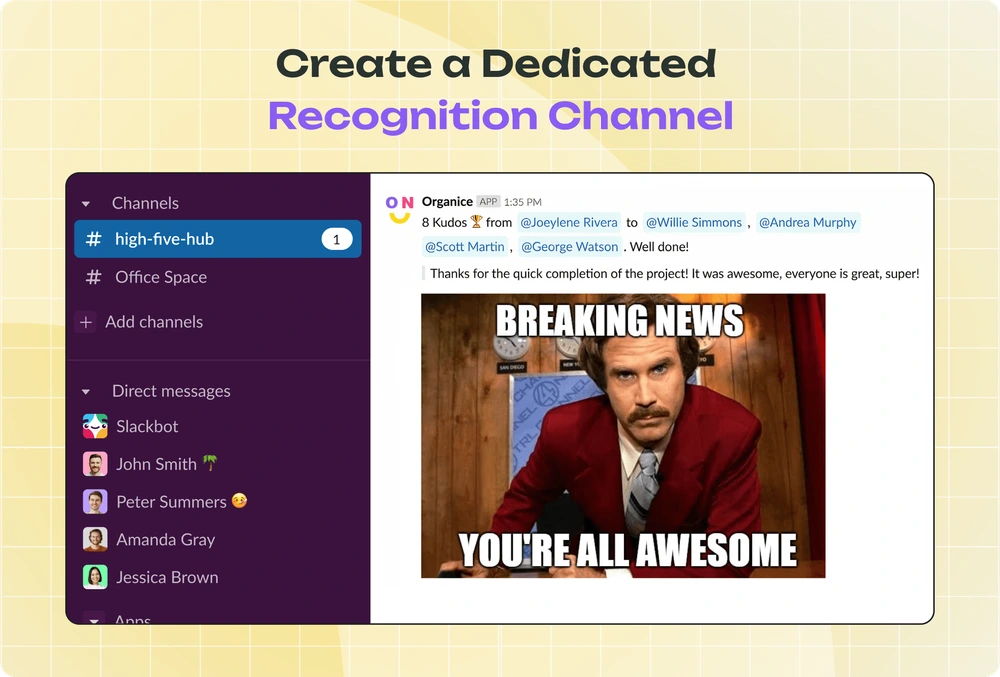
17. Make the recognition channel the default, not the exception. For a distributed team, the #kudos channel from earlier in this list isn't a nice-to-have addition to hallway recognition, it's the entire mechanism. Treat it as core infrastructure, not an experiment. A quiet week in the channel is a signal to post something yourself, not proof the habit stopped working.
18. Recognize async work by name. A remote employee who solved a problem overnight or across time zones often has no one to tell in real time. A specific shoutout the next morning closes that gap and makes sure the team notices async contributions, not only synchronous ones. Naming the exact problem solved, instead of a generic "great work overnight," shows someone read what happened instead of reacting to a notification.
19. Video-optional recognition. Some remote employees find on-camera praise uncomfortable. A written, specific shoutout in Slack works for people who'd rather not be put on the spot in a video call, and it's every bit as visible to the team. This matters more for a distributed team, where video calls already take up a larger share of a person's day than they would in an office. Offering the choice, instead of defaulting to video, is what makes this recognition rather than one more meeting request.
Small, structured ideas for teams ready to formalize recognition
Once the habits above are running on their own, these employee recognition program ideas turn them into something more durable, without adding bureaucracy your team didn't ask for. This is the stage most SMB teams reach a year or two after the first shoutout channel goes up, once enough people are using it that a little structure keeps it fair.
20. A simple points-based kudos system. Once informal recognition is already a habit, a lightweight points system, redeemable for something small, gives people a reason to keep the habit going without turning it into a heavy program. Start simple; a complicated points system is a common reason recognition programs stall out at small companies. Tie points to something people want, an extra half-day off or first pick on a project, rather than a company logo item nobody would choose on their own. Browse real kudos examples for employees if you want to see what redeemed points look like in practice.
Whatever combination of these you try, pick two or three to start this week rather than attempting all twenty at once. A recognition habit your team follows beats an ambitious program that stops after the first month without anyone deciding to end it. Set a reminder to check in on it in thirty days: still running, or already forgotten, either answer tells you something worth acting on. If your team already lives in Slack, OrgaNice's kudos feature puts the recognition channel, the peer nominations, and the lightweight points system from this list right where your team already works, no new login required.
Questions, answered.
The ideas that work best for a small business are the ones that don't need a budget line or a dedicated platform: a public shoutout in a Slack channel, a specific handwritten note, a peer nomination for a rotating team title. Employee recognition ideas for small businesses succeed when they're built into a habit your team already has, not a new program someone has to remember to run. Start with one idea, run it for a month, and only add a second once the first one sticks without a reminder.
Free employee recognition ideas work when they're specific and timely, not when they cost money. A detailed public thank-you, first pick on the next project, a five-minute shoutout at the start of a team meeting, or a peer-nominated recognition all cost nothing and land harder than a generic gift card would. The constraint is time and attention, not money, so the real test of a free idea is whether it survives a busy week without someone deciding to skip it. An idea that only works when things are calm hasn't become a habit yet; a real recognition habit survives the busy weeks too, the weeks your team needs it most.
Virtual employee recognition ideas work best when they happen in the same place your remote team already communicates, not a separate video call or a survey tool nobody opens. A dedicated recognition channel in Slack, a weekly recognition digest, and public thread replies praising specific work all translate well to a distributed team without adding a new tool to check. The common thread is visibility that doesn't depend on someone happening to be online at the same moment as everyone else.
Weekly beats monthly. Only 19% of employees say they receive meaningful recognition on a weekly basis, and the ones who do report far higher belonging and are more than twice as likely to be performing at their best. A light, frequent habit, one real shoutout a week, beats an elaborate quarterly event most teams never get around to running twice. If a recognition idea needs planning more than a day in advance, it's a good candidate for a quarterly event, not a weekly habit. The best weekly ideas take under a minute to give: a message, a reaction, a specific line in a meeting that's already happening.
Recognition is specific: naming the exact thing someone did well. Appreciation is broader: acknowledging someone's value or effort in general terms. Both matter, but recognition drives more of the retention effect, because it tells someone their teammates noticed their actual work, not only that they're a valued member of the team in the abstract. In practice, most teams need both: appreciation to set the tone and recognition to reinforce the specific behavior worth repeating. [Building a real culture of recognition](/blog/creating-a-culture-of-recognition) covers how the two work together over time.