

If you run a team of 4 to 12 people and have five minutes at the start of Friday's standup, the best team building activities for small groups are a one-word check-in or a shout-out round. With 30 minutes, run the Marshmallow Challenge or a pre-mortem, and with a half day, cook lunch together or volunteer. A 2009 meta-analysis of team building studies found a positive, moderate effect on every team outcome it measured, strongest on how members feel about each other and how they work together. We reviewed the five top-ranking lists for this search and kept 25 activities that work for adults at work. OrgaNice builds recognition and celebration tools for Slack-first teams of 10 to 300 people, so each activity here was judged on one question: would a busy small team run it again next week?
- All 25 activities at a glance
- What changes when the group is 3 to 12 people
- 5-minute team building activities for small groups
- 30-minute activities for communication and problem solving
- Activities that help a small team get to know each other
- Half-day activities worth blocking the calendar for
- Virtual team building activities for small groups
- Team building activities that fall flat with adults at work
- How to turn one session into a weekly habit
- How to tell whether team building is working
All 25 activities at a glance
Every activity in this list fits a group of 3 to 12 adults, and 20 of the 25 cost nothing. The table gives the group size, time, cost, and remote fit for each one, so you can pick by the time slot you have before reading the instructions. Twenty-two are indoor team building activities for small groups that fit a meeting room or a video call, and the other three need a kitchen, a venue, or a trip out.
Costs are estimates for supplies at US retail prices, checked November 2026. Times include a short debrief.
What changes when the group is 3 to 12 people
In a small group, nobody can hide, so the activity has to be safe to join and safe to sit out. Most team building games were written for workshops of 15 or more, where a quiet person can stand at the back. With six people, everyone's silence is visible, and one dominant voice sets the tone for the whole session.
That visibility is also what makes small groups worth the effort. BetterUp's research on workplace connection found that 43% of employees don't feel connected to their colleagues, and on a team of eight, that's three or four people working next to strangers. Four rules decide whether an activity works at this size:
- Pick by the time slot you already have. A 5-minute opener in an existing meeting gets run. A 2-hour session that needs a calendar invite gets postponed twice and dropped.
- Stay close to real work. Adults at work take part more readily in an activity that produces something useful, like a list of project risks or a note on how a colleague likes feedback, than in a game with no link to the job.
- Give everyone an exit that doesn't stand out. Let people pass on any question, and make "pass" a normal answer by using it yourself once. Google's Project Aristotle study of 180 teams ranked psychological safety first of the five things that set effective teams apart.
- If one person is remote, everyone is remote. On a hybrid team, run the activity on video for the whole group. Three people laughing around a table while one person watches on a laptop screen undoes the point.
Above eight people, split into pairs or trios for the main part of an activity and bring the group back together for the last five minutes.
Image brief: Four colleagues around a meeting table in a small office, mid-way through the Marshmallow Challenge: a wobbly spaghetti tower held together with tape, a marshmallow on top, one person holding a phone timer. The mood is focused and slightly chaotic, a normal Tuesday afternoon, not a staged corporate retreat.
5-minute team building activities for small groups
These six quick team building activities fit inside the first five minutes of a standup, a weekly sync, or a retro, so they need no extra meeting. Run one for a month before you switch. Trust comes from the repetition.
- One-word check-in (3–12 people, 3 minutes, $0). Each person says one word for how they're arriving at the meeting: "swamped", "rested", "curious". Nobody asks follow-up questions unless the person adds more. It takes 20 seconds per person and tells a manager more about the team's week than a status update.
- Rose, thorn, bud (3–8 people, 5–8 minutes, $0). Each person names one win from the week (rose), one problem (thorn), and one thing they're looking forward to (bud). Keep the thorn to one sentence, so the round doesn't turn into a problem-solving session. It works well at the start of a Monday sync.
- Would you rather: work edition (3–12 people, 5 minutes, $0). Ask one question and let everyone answer: "Would you rather have no meetings for a month or no Slack for a week?" Work-edition questions start better conversations than random ones, because the answers reveal how people like to work.
- Three things in common (4–12 people, 5 minutes, $0). Split into pairs or trios for three minutes. Each group finds three things they share that nobody would guess from looking at them, then reports the strangest one. "We all hate cilantro" doesn't count, but "we all learned to swim as adults" does.
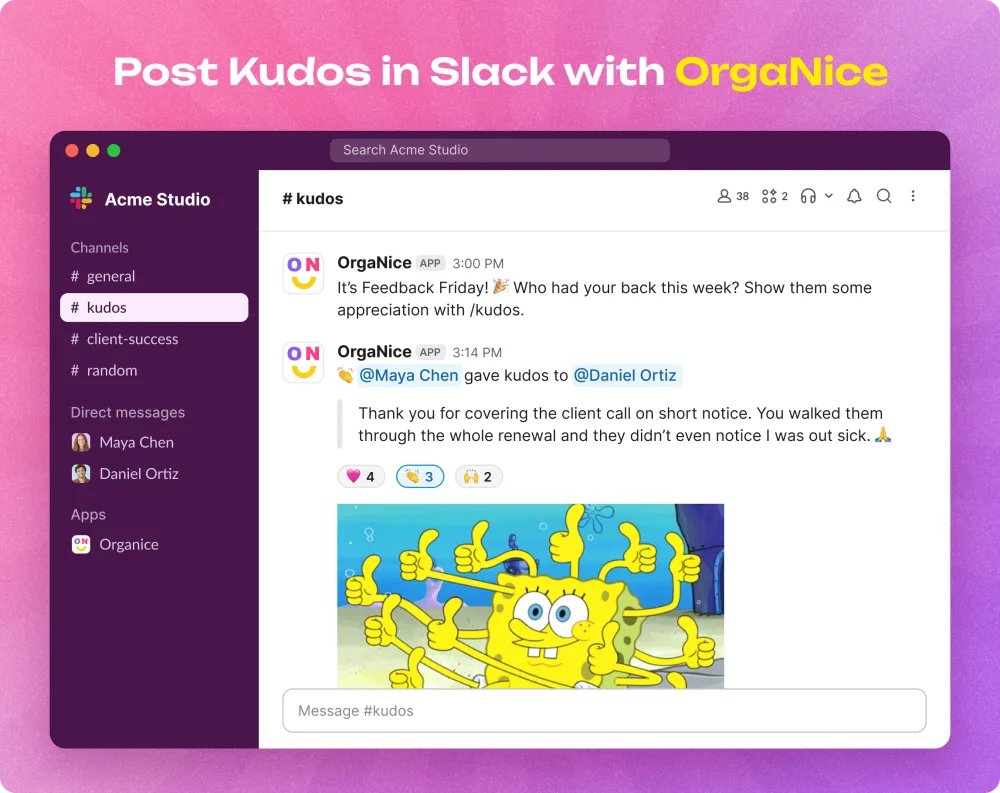
- Shout-out round (3–12 people, 5 minutes, $0). Each person names one specific thing a teammate did that week and what it made possible. "Thanks to Priya for rewriting the onboarding doc, because two new hires used it without asking me a single question" lands harder than "thanks, everyone". Our guide on how to give a shout-out to a coworker has examples to start with.
- Desk show and tell (3–10 people, 5–10 minutes, $0). Each person grabs one object within arm's reach and explains it in 60 seconds. It works on video calls, and it gives quiet teammates a topic they control.
30-minute activities for communication and problem solving
These six office team building activities for small groups take 10 to 30 minutes and give a small group a shared problem to solve. Each one ends with a 5-minute debrief: what worked, what didn't, and what the group would do differently on a real project.
- Marshmallow Challenge (teams of 3–4, 30 minutes, under $10). Each team gets 20 sticks of dry spaghetti, a yard of tape, a yard of string, and one marshmallow, and has 18 minutes to build the tallest freestanding tower with the marshmallow on top. In the debrief, ask each team when they first put the marshmallow on top and what happened when they did.
- Back-to-back drawing (pairs, 15 minutes, $0). One person holds a simple picture made of shapes and describes it. The other draws it without seeing the picture or asking questions. Swap roles, then allow questions in the second round and compare the drawings. The gap between round one and round two shows the value of checking understanding.
- Desert island ranking (3–6 per group, 25–30 minutes, $0). Give everyone a list of 12 items salvaged from a shipwreck: a mirror, a tarp, a knife, a radio with no batteries, and so on. Each person ranks them alone for five minutes, then the group agrees on one ranking. Compare the group ranking with each person's own list. The debrief question is whose view changed and why.
- Blind brick build (3–6 people, 20 minutes, about $20 for one reusable set). One person sees a small model built from plastic bricks. The builders can't see it and must recreate it from the describer's words alone. Rotate the describer each round. The debrief shows how often a describer skips the detail the builders needed most.
- Pre-mortem (4–10 people, 30 minutes, $0). Pick a live project and announce that it failed six months from now. Each person spends five minutes writing every reason it failed, then the group reads them out and picks the top three to act on. It's the one activity on this list that produces a work output, and it gives junior people permission to say what worries them.
- Silent line-up (5–12 people, 10 minutes, $0). The group lines up by birth month, or by the number of years they've lived in their city, without speaking. People improvise with fingers, nods, and pointing. It's a quick energizer for an in-person offsite, and the debrief on who took charge and how is often more useful than the line-up.
Activities that help a small team get to know each other
These five team bonding activities give a small team the personal context that makes working together smoother: how someone likes feedback, what they do on weekends, why they always go offline at 4 pm. They work best a few weeks after someone joins, or right after the team changes shape.
- Two truths and a lie (3–10 people, 10–15 minutes, $0). Each person shares three statements about themselves, one of them false, and the group guesses which one is the lie. It's the most familiar game on this list for a reason: it gets people talking about their lives without anyone having to volunteer something heavy.
- Personal maps (3–8 people, 30 minutes, $0). Each person draws a simple mind map of themselves with five branches: home, family, hobbies, work history, and goals. Share them in pairs, then pin them in a shared folder. Remote teams can use a free whiteboard tool.
- User manual of me (3–12 people, 30 minutes, $0). Each person writes a short note on how they work: their focus hours, how they prefer feedback, what stresses them out, and how to tell when they're overloaded. Share the notes in a Slack channel and read two aloud each week. For a small team, this is the most useful 30 minutes on the list.
- Hot seat questions (3–12 people, 5 minutes a week, $0). Each week, one person answers three questions drawn from a shared list, at the start of a regular meeting. "What was your first job?" and "What are you reading?" are good starters. A team of ten works through everyone in ten weeks.
- Coffee roulette (pairs, 20–30 minutes a week, $0–$10 per pair). Pair two people at random each week for a coffee or a video call with no agenda. On a team of eight, a full rotation where everyone meets everyone takes seven weeks. With an odd number of people, make one trio each week.
Half-day activities worth blocking the calendar for
These four fun team building activities for small groups need a half day, so save them for a quarter's end, an offsite, or the week after a big launch. Book them at least two weeks ahead, run them during work hours, and keep the agenda loose.
- Cook-together lunch (4–12 people, 2–3 hours, about $15–$25 a head in groceries). Pick a menu with several parts, like tacos with three fillings, and split the team into stations. Cooking gives everyone a job and a reason to talk. Ask about dietary needs a week ahead, so nobody ends up eating bread rolls alone.
- Volunteer half-day (4–12 people, 3–4 hours, $0). Spend a morning at a local food bank, park cleanup, or charity warehouse. Call ahead, because food banks and park programs schedule group shifts in advance. Let the team vote on the cause, and make it optional for anyone with physical limits or strong views on the charity.
- Escape room (4–8 people per room, 60 minutes plus travel, a per-person ticket). Escape rooms are built for small groups, which makes them one of the few commercial activities sized for a team like yours. Book a room for beginners if the group hasn't played before. Virtual escape rooms exist for remote teams, but they lose the physical clues that make the in-person version fun.
- Fix-it afternoon (3–12 people, 3–4 hours, $0). Everyone lists the small, annoying problems nobody has time for: the broken internal doc, the Slack channel nobody archives, the onboarding checklist from 2023. Pairs pick one each, fix it, and show the result at 4 pm. The team leaves with a dozen small wins and a clear picture of who works well together.
Virtual team building activities for small groups
These four virtual team building activities run on video or in a Slack channel, so a remote or hybrid team takes part on equal terms. Run at least half of your remote activities async, because a live call at 9 am in New York is 3 pm in Warsaw and 10 pm in Manila. For a longer list of online ideas, see our 20 remote team building activities.
- Team-made trivia (3–12 people, 20–30 minutes, $0). A week ahead, everyone submits three questions about themselves: "Which country did I live in before this job?" Someone builds a quiz from the answers, and the team plays it on a call. The questions come from the team, so the answers stay interesting.
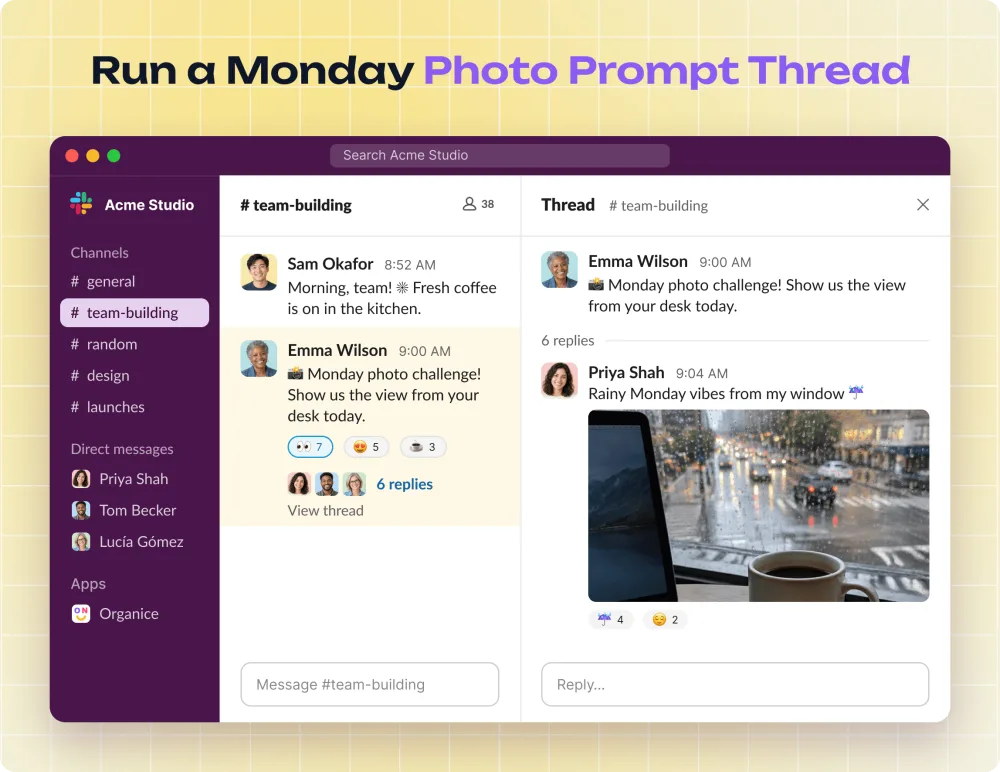
- Photo prompt thread (any size, 2 minutes, async, $0). Post a prompt in a Slack channel each Monday: the view from your desk, your lunch, the last photo on your camera roll. People reply when they're online. It costs nothing and takes two minutes. In our experience, it's the activity remote teams keep running the longest.
- Online drawing game (3–12 people, 15–20 minutes, $0). Free browser games like skribbl.io and Gartic Phone need no sign-up and run in a private room for your team. One person draws a word while everyone else guesses. It's the closest thing to a funny team building activity for small groups that works online.
- Guess whose desk (4–12 people, 15 minutes, $0). Everyone sends a photo of their workspace to the organizer in private. The organizer posts them one at a time, and the team guesses whose desk is whose. Hybrid teams can mix home and office desks.
Team building activities that fall flat with adults at work
Some activities do more harm than good on an adult team. These five are the most common, and each one has a better replacement in the list above.
- Trust falls and anything with physical contact. Catching a colleague, holding hands in a human knot, or leading someone blindfolded crosses lines for many adults. Use back-to-back drawing or the blind brick build instead. Both test trust in communication with no physical contact.
- Forced vulnerability. Activities that ask people to share their biggest fear or a childhood memory in front of their manager put people on the spot. Let people choose how much to share, and keep the questions at the level of "what are you reading?"
- Competitive games where the same people always win. A trivia game that rewards pop culture knowledge, or a physical race, sorts the team into winners and spectators. Build the trivia from the team's own answers, or score by team instead of by person.
- Activities after hours or with alcohol at the center. An evening at a bar leaves out parents, people who don't drink, and anyone with a long commute. Hold team building during work hours, when it counts as work.
- Camp games written for kids. Many popular team building lists come from youth programs, which is why they include ropes, PVC pipes, and running games. Adults at work go along with them, but they rarely ask for a second round.
How to turn one session into a weekly habit
A small team gets more from a 5-minute habit every week than from one big event a year. In our experience, an offsite lifts the mood for a week or two before the old patterns return. A shout-out round every Friday or a photo thread every Monday keeps the connection going between events, and it fits the employee engagement ideas that run themselves, covered in our list of 40+ employee engagement ideas.
Here's a rotation for a team of 4 to 12 people:
- Every week: one 5-minute opener in an existing meeting, the same one for a month.
- Every week, async: a photo prompt thread or hot seat questions in Slack.
- Every month: one 30-minute activity, like a pre-mortem on the next project or a round of team-made trivia.
- Every quarter: one half-day, like a fix-it afternoon or a volunteer morning.
- On every milestone: a public message for each birthday, work anniversary, and new hire, so the whole team sees each person's milestones.
The weekly habits are the ones that slip first, because someone has to remember them. On a Slack-first team, let the tooling carry that load. OrgaNice posts a kudos in Slack in under 10 seconds, ties it to your company values, and sends a Feedback Friday reminder so the shout-out round happens even in a busy week. Here's how the OrgaNice kudos app works in Slack. OrgaNice's birthdays and anniversaries app posts those milestones from the org chart, so nobody has to keep a list.
How to tell whether team building is working
Team building is working when the team behaves differently on a normal Tuesday. Enjoying the offsite is a weaker signal. After a month of weekly activities, look for these five signals:
- Quieter people speak earlier in meetings. If the person who used to stay silent until asked now adds a point in the first ten minutes, the room feels safer.
- People ask each other for help directly. Count how often someone posts "can anyone help with this?" in Slack instead of going through a manager.
- Shout-outs come from peers as well as managers. Peer recognition is the clearest sign that people notice each other's work.
- Fewer "who owns this?" questions. A team that knows each other's work ends up with fewer dropped handoffs.
- People keep the habit going without you. If someone else posts the Monday photo prompt when you're on vacation, the habit has stuck.
For a number to track, send a two-question pulse survey once a month: "How connected do you feel to the team this month, on a scale of 1 to 5?" and "What's one thing that would help?" Compare the scores quarter to quarter alongside the signals above. For the wider picture of what drives engagement on a team your size, our guide to employee engagement strategies for small teams covers the rest.
Start small: pick one 5-minute activity from this list for next week's standup, set up one async Slack thread, and check the five signals in a month. If the quiet people are talking earlier and the shout-outs are coming from peers, add a 30-minute activity. If not, try a different opener before planning anything bigger.
Questions, answered.
What are good team building activities for small groups of adults at work?
Pick activities that sit close to real work and don't ask for physical contact or personal confessions. For 3 to 12 adults, the strongest picks are a shout-out round at the start of a meeting, a pre-mortem on a live project, a user manual of me, and the Marshmallow Challenge with a short debrief. Each one takes 30 minutes or less, costs under $10, and gives the team something useful beyond the activity itself.
What are quick team building activities for small groups?
The quickest options fit inside the first five minutes of a meeting you already hold: a one-word check-in, rose, thorn, bud, a work-edition would you rather, or a shout-out round where each person names one specific thing a teammate did that week. None needs materials or a facilitator, and all four work on a video call. Run the same one for a month before switching, so it becomes a habit.
What are some no cost team building activities for small groups?
Twenty of the 25 activities in this list cost $0, including two truths and a lie, back-to-back drawing, the desert island ranking, a pre-mortem, a volunteer half-day, and a fix-it afternoon. The rest cost little: coffee roulette (up to $10 a pair if you buy the coffee), the Marshmallow Challenge (under $10 in supplies), a blind brick build (one reusable set, about $20), a cook-together lunch (about $15 to $25 a head in groceries), and an escape room (a per-person ticket).
How do you run virtual team building activities for small groups?
Keep live sessions short, 15 to 30 minutes, and run at least half of your activities async in a Slack channel so people in other time zones take part on their own schedule. Team-made trivia, a free browser drawing game like skribbl.io, and a weekly photo prompt thread all work well online. If even one person on a hybrid team is remote, run the activity on video for everyone.
How many people is a small group for team building?
For team building, a small group is 3 to 12 people. Below 3, an activity turns into a one-on-one conversation. Above 8, quieter people start to drop out of whole-group discussion, so split into pairs or trios for the main part of the activity and bring everyone back together for the debrief. Most of the activities in this list are designed for that split.
How often should a small team do team building activities?
Run a 5-minute activity every week and a longer session once a month or once a quarter. The weekly habit builds more than an annual offsite, because a small team's working relationships change week to week and a single event fades within a month. Recognition, birthdays, and work anniversaries give you a natural weekly reason to stop and acknowledge each other without planning an event.